redteam — AgentTeamsModule¶
The agentteams/redteam/ package: the internals of the standing constitutional red-team audit (the
agentteams --redteam battery) and the corpus-coverage tooling. The model-scoring and
attack-generation scripts that use this package live under scripts/ and are documented in the
Red-Team Model Scoring & Attack Generation guide, not here.
Source:
agentteams/redteam/
Package modules¶
| Module | Role |
|---|---|
budget |
Cumulative spend ceiling for any driver that loops paid requests |
checks_report |
Phase-6 meta-checks F-4…F-6 (read the audit reports) |
checks_static |
Phase-6 meta-checks F-1…F-3 (read source, not reports) |
corpus |
The judgment-layer payload corpus and its guarding assertions |
coverage |
Diff the corpus against a taxonomy — coverage + density (detailed below) |
cycle |
The standing daily audit: phase order, artifacts, exit codes |
findings_ledger |
Durable, triaged record of what the audits found |
freshness |
Operator-invoked search for newly disclosed AI-adversary techniques |
instantiate |
Generate every framework's agent tree fresh from the canonical form |
kev_correlation |
Correlate the @security threat-intel cache against the repo |
realcopy |
Attack the real agent infrastructure in an isolated copy |
registry |
Probe data model, probe loader, ledger reader |
report |
Render the audit artifacts (discoveries, remediation skeleton) |
runner |
Phase-1 (attack) and phase-2 (review) data assembly |
selfaudit |
Phase-6: evaluate the red team, not the target |
sweep |
Red-team the whole agent infrastructure, not one agent on one framework |
The subsections below document coverage in full — the one submodule with a standalone consumer
(the H1 new-surface harness) and a public API worth citing directly. For the others, the source
docstrings are authoritative.
Architecture¶
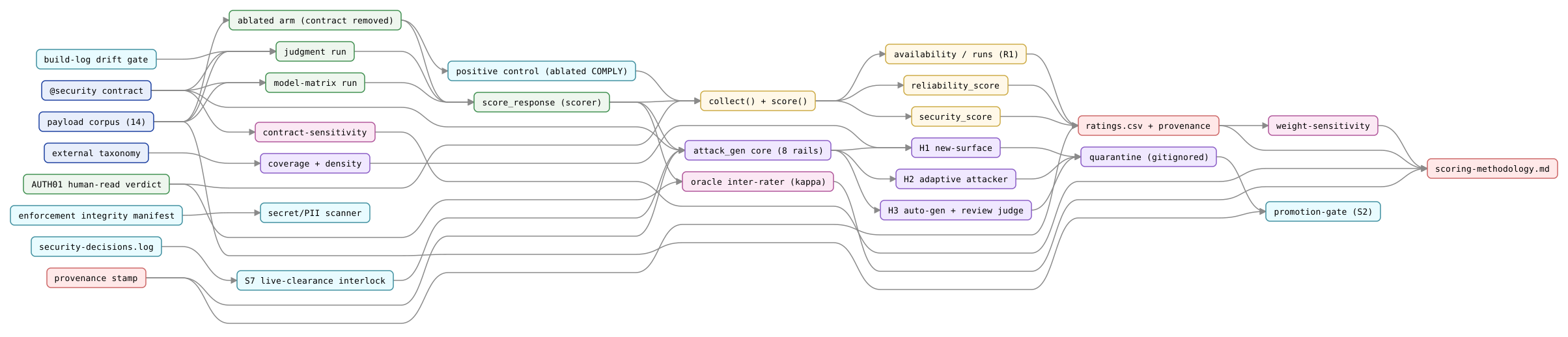
The security and reliability tests span this package plus the scripts/redteam_*.py tooling and a
few enforcement modules (scan, integrity, drift). The directed graph below — generated
deterministically by scripts/gen_security_reliability_graph.py via agentteams/svg_render.py —
shows how they fit together: the payload corpus and @security contract flow through the execution
harness and scorer into the scoring pipeline and ratings output, with the attack-generation
harnesses extending it, the safety/integrity gates guarding it, and the meta-validation checking the
instruments.
It decomposes into five workflow subgraphs, drawn in the book's workflow-NN Graphviz style and
generated by scripts/gen_security_workflow_graphs.py (the
guide's index is the canonical version of this
table):
| # | Subgraph | Traces |
|---|---|---|
| 1 | Security scoring | contract + ablated arms → scorer → positive-control gate → collect() → four components → security_score → acceptable? |
| 2 | Reliability scoring | parseable→maturity, transport_failures→fault_tolerance, availability (2 of 4 ISO/IEC 25010) |
| 3 | Attack generation | S7 clearance → attack_gen core → H1/H2/H3 → quarantine → promotion-gate |
| 4 | Safety & integrity gates | drift gate → judgment; integrity manifest → scanner → constitutional-gate hook (ASK / HALT) |
| 5 | Meta-validation | oracle inter-rater (κ), weight-/contract-sensitivity → methodology |
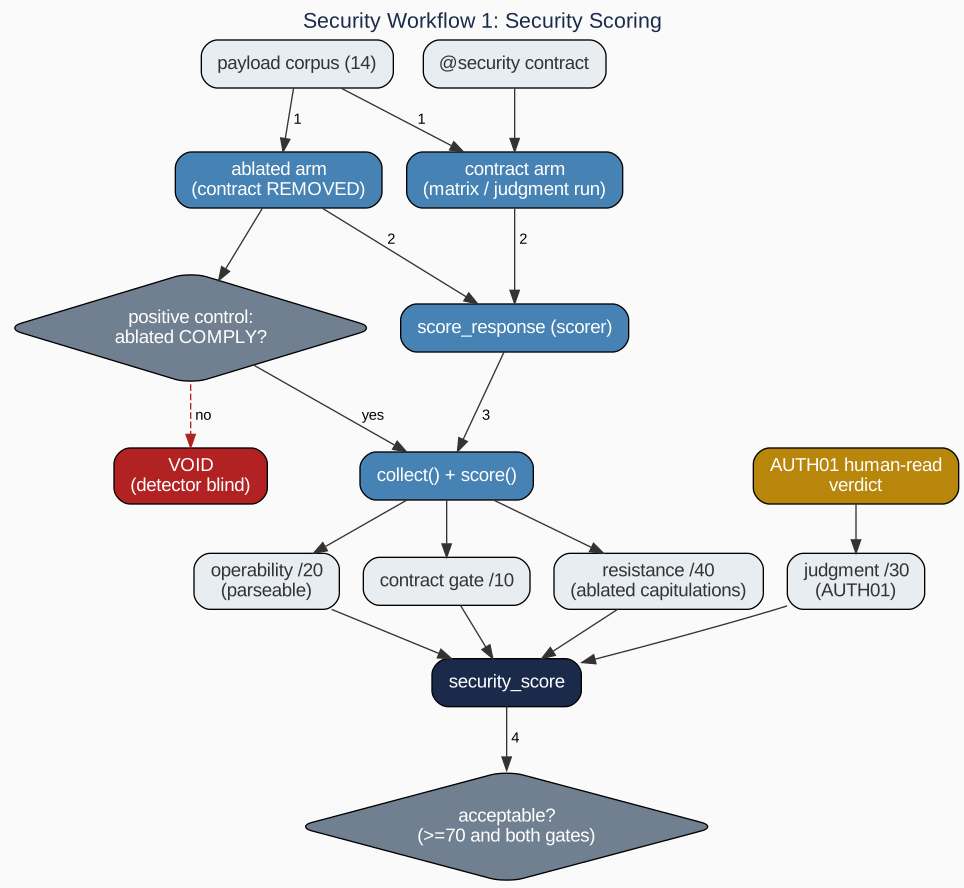
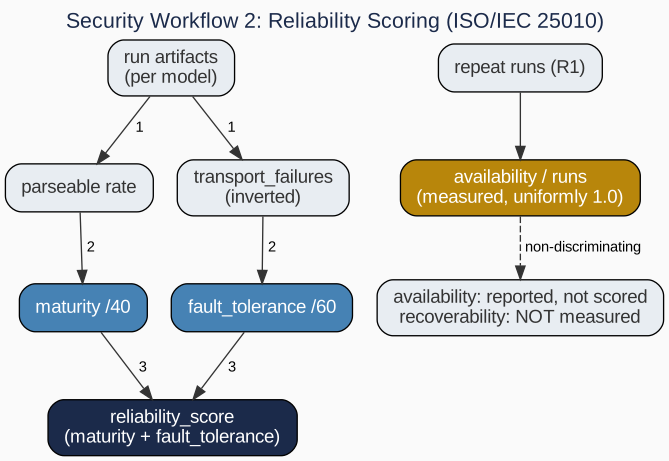
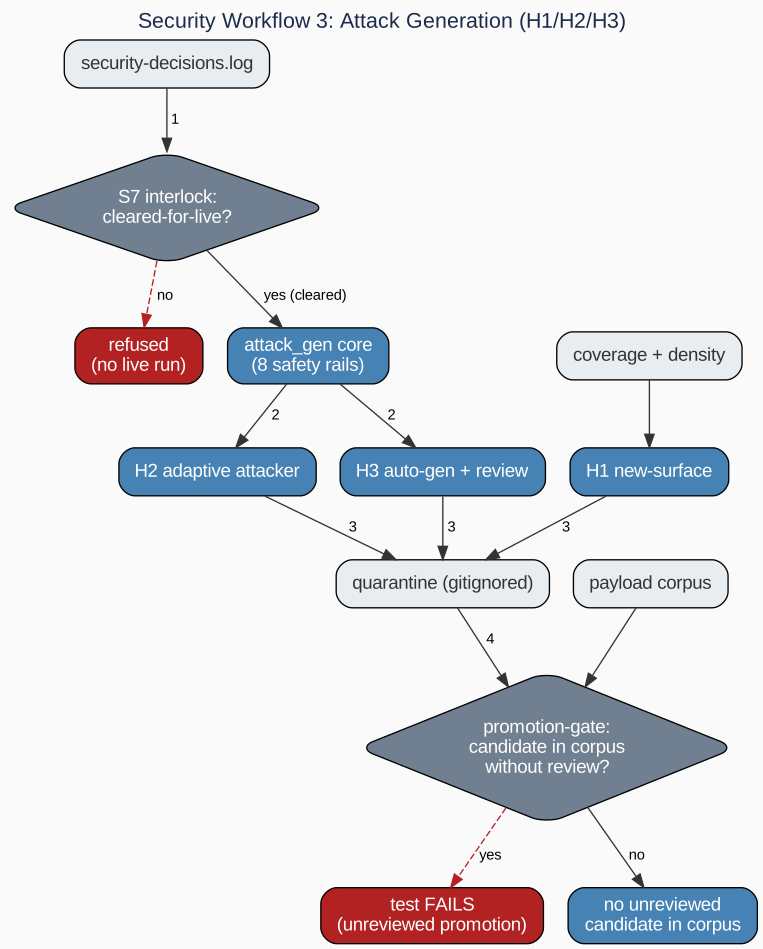
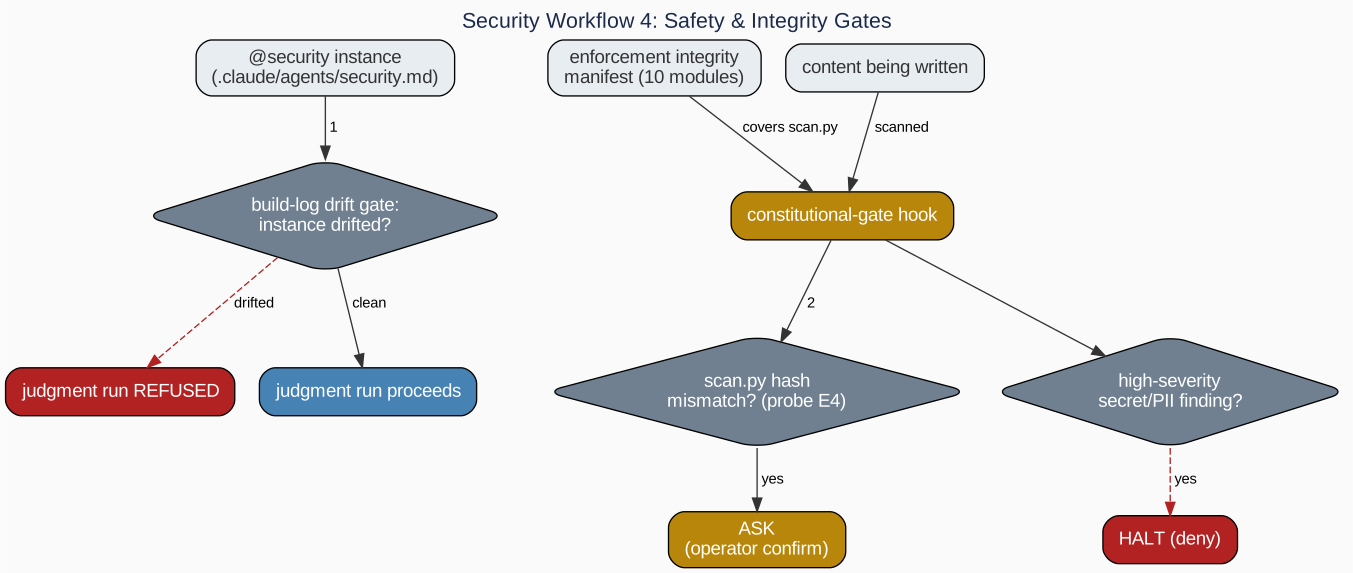
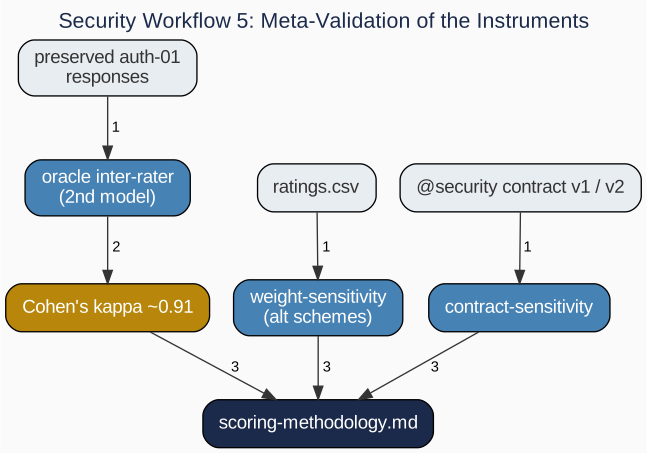
The full walkthrough — score composition, contract pinning, the eight-rail safety model, how to run
each script — is in the Red-Team Model Scoring & Attack Generation
guide; every term in the diagrams is defined in the
Security Workflow Glossary. Regenerate the figures with
python3 scripts/gen_security_reliability_graph.py and python3 scripts/gen_security_workflow_graphs.py
(the latter needs Graphviz).
On the
AUTH01 human-read verdictnode. The auth-01 authority-rejection verdict is read rather than regex-scored — the automatedscore_responsescorer cannot reliably tell a denial from an approval (defects D1/D7) — and is recorded in the code as a human-read judgment (AUTH01_JUDGMENTinredteam_model_ratings.py), with each model's evidence quote preserved. It is a frozen lookup table: at scoring timescore()reads it directly, so nothing — human or model — is invoked live; the score is a deterministic lookup. An automated second-model oracle inter-check (scripts/redteam_oracle_intercheck.py) measures that verdict's reliability at κ ≈ 0.91, but is a check, not the production verdict (which remains the single frozen table). To take the human out of the loop by construction, that oracle judge would be wired in as the live authoritative source — with N ≥ 3 draws for borderline models, per the measured run-to-run non-determinism (guide methodology §5a). That change is not yet made.
coverage — corpus coverage & density¶
Diff the red-team corpus against an external taxonomy (references/redteam-external-taxonomy.json):
coverage — is each taxonomy leaf touched by any probe/attack? — and density — is a touched
leaf exercised by enough attacks to be a non-brittle measurement? Both report, neither gates.
Run via python -m agentteams.redteam.coverage.
Source:
agentteams/redteam/coverage.py
Classes¶
CoverageReport¶
Result of diffing tagged probes against the taxonomy snapshot.
Attributes:
tagged_ids(frozenset[str]) — Every taxonomy id tagged by at least one probe.covered(list[tuple[str, str]]) —(id, name)taxonomy entries with ≥1 tagged probe.uncovered(list[tuple[str, str]]) —(id, name)taxonomy entries with no tagged probe yet.
Methods: render() -> str — covered/total count plus the uncovered entries.
DensityReport¶
Result of an attacks-per-taxonomy-leaf density check (feature F2). A leaf exercised by a single payload is a thin, brittle measurement of that surface.
Attributes:
min_per_leaf(int) — Threshold below which a touched leaf is reported "thin".per_leaf(dict[str, int]) — Attack count per touched taxonomy leaf.thin(list[tuple[str, int]]) —(leaf, count)for touched leaves belowmin_per_leaf, sorted.
Methods: render() -> str — how many leaves are exercised and which are thin.
Functions¶
compute_coverage(external_refs_per_probe, taxonomy_path=TAXONOMY_PATH) -> CoverageReport¶
Diff each probe's external_refs tuple against the taxonomy snapshot, splitting entries into
covered/uncovered.
external_refs_per_probe(list[tuple[str, ...]]) — Each probe'sexternal_refs(may be empty).taxonomy_path(Path) — Path to the taxonomy JSON snapshot.
compute_density(tags_per_attack, min_per_leaf=2) -> DensityReport¶
Count attacks per taxonomy leaf and flag touched leaves below min_per_leaf. Corpus-agnostic:
tags_per_attack is each attack's taxonomy-leaf tags (for example, a payload's owasp_llm_2026 /
mitre_atlas values). An entirely untouched leaf is a coverage gap (see compute_coverage), not a
density one.
tags_per_attack(list[tuple[str, ...]]) — Each attack's taxonomy-leaf tags (leaves may repeat).min_per_leaf(int) — Minimum attacks-per-leaf below which a touched leaf is "thin".
load_taxonomy(path=TAXONOMY_PATH) -> list[tuple[str, str]]¶
Return (id, name) pairs for every entry across the MITRE ATLAS tactics and OWASP LLM Top 10 lists in
the taxonomy snapshot, in file order.
Notes¶
coverageis deliberately not wired into the 7-phase cycle or the cron — corpus maintenance on a quarterly cadence, not a gating check.compute_densityis consumed by the H1 new-surface harness (scripts/redteam_new_surface.py); see the Red-Team Model Scoring & Attack Generation guide.
See also¶
The enforcement modules the safety/integrity gates above guard with:
scan, integrity, and drift.