plan_steps — AgentTeamsModule
Tolerant reader for plan .steps.csv artifacts.
Plans in tmp/by-week/<ISO-week>/<slug>.steps.csv describe sequenced handoffs between agents. Some cells (typically notes) contain quoted multi-line text. This module's read_steps wraps csv.DictReader with the conventions used across the project — quoted multi-line cells preserved, rows without a step field skipped, missing cells coerced to empty strings.
Introduced alongside handoff_payloads so the chain comparator can operate on dict rows.
Sibling readers. Three modules define a
read_steps/PlanSteppair over related-but-different schemas: this one returns plain dict rows keyed by the CSV header;plan_steps_todoparses the strict 11-column todo-projection schema intoPlanStepdataclasses; andparallel_planuses a tolerant 7-column runtime reader. Pick by which schema your CSV follows.
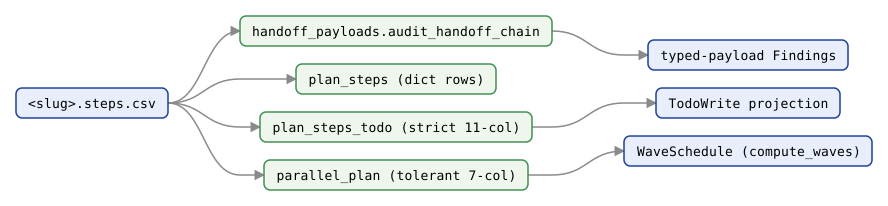
Readers at a glance
One <slug>.steps.csv feeds three distinct readers — this module's dict rows,
plan_steps_todo's TodoWrite projection, and parallel_plan's
wave schedule — plus handoff_payloads's typed-payload chain check.
Generated deterministically from scripts/gen_api_cluster_figures.py.
Source:
agentteams/plan_steps.py
Functions
read_steps(path)
Source:
agentteams/plan_steps.py
Read a plan .steps.csv. Each returned dict is keyed by the CSV header row; missing values are normalized to empty strings (not None).
Args:
path(Path | str) — Path to a plan.steps.csvartifact.
Returns: list[dict[str, str]] — One dict per data row. Rows whose step cell is empty are skipped (this allows trailing blank lines and comment-style header gaps without raising).
Malformed rows: if a row has more comma-separated values than the header (typically an unquoted comma or a stray quote inside a hand-edited cell shifting every subsequent column), read_steps emits a UserWarning naming the file and physical line number, and drops the unassigned overflow rather than leaking it into the returned dict under a None key. This is a warning, not an exception — well-formed rows elsewhere in the same file are read normally. Callers that must treat this as fatal can use warnings.simplefilter("error") around the call.
Example:
from pathlib import Path
from agentteams.plan_steps import read_steps
from agentteams.handoff_payloads import audit_handoff_chain

steps = read_steps(Path("tmp/by-week/2026-W21/my-plan.steps.csv"))
findings = audit_handoff_chain(steps)
for finding in findings:
    print(f"{finding.severity} {finding.code}: {finding.message}")
See Also
handoff_payloads— typed handoff substrate that consumes the rows returned here.