model_routing — AgentTeamsModule
Generate framework-neutral model-routing contracts for agent cost/capability tiering.
Assigns each agent in a team to a tier role (cheap, primary, fallback) based on manifest governance classification. The contract is emitted only when the caller passes --cost-routing; this module is pure and never decides on its own.
Source:
agentteams/model_routing.py
Tier decision at a glance
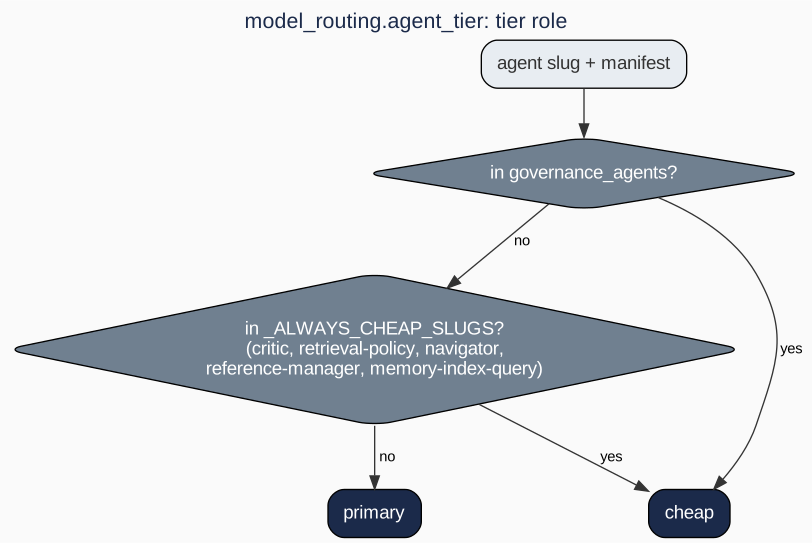
agent_tier is two predicates: an agent maps to cheap if it is in governance_agents or in
_ALWAYS_CHEAP_SLUGS, else primary. (fallback is a MODEL_TIERS resolution tier, not an
agent_tier output.) Generated deterministically from scripts/gen_api_decision_figures.py (Graphviz).
Design Principles
- Framework-neutral — Assigns tier roles, not concrete model strings
- Off by default — Only emitted when explicitly requested (
--cost-routingin CLI) - Deterministic — Pure functions; same manifest always yields same routing
- Conservative — Unknown agents default to
primary(never downgraded) - Governance-driven, plus a small fixed allowlist — Tier rule is primarily derived from the manifest (
governance_agentsmembership), plus a fixed 5-slug allowlist (_ALWAYS_CHEAP_SLUGS) always routed tocheapregardless of manifest membership
Constants
ROUTING_SCHEMA_VERSION
Source:
agentteams/model_routing.py
Current schema version for routing contract artifacts. Used to detect compatibility between build and consumer versions.
Type: str
Current value: "1.0"
MODEL_TIERS
Source:
agentteams/model_routing.py
Tuple of recognized tier role names.
Type: tuple[str, ...]
Value: ("primary", "cheap", "fallback")
Functions
agent_tier(slug, manifest)
Source:
agentteams/model_routing.py
Determine the tier role for a single agent, pure.
Args:
slug(str) — Agent slug (e.g.,"quality-auditor").manifest(dict[str, Any]) — Team manifest dict fromanalyze.build_manifest().
Returns: str — Tier role: one of MODEL_TIERS ("primary", "cheap", "fallback").
Rule:
- If
slugis inmanifest['governance_agents']orslugis one of 5 hardcoded always-cheap slugs →"cheap"(read-only, structured, cost-optimizable) - Otherwise →
"primary"(conservative; unknown agents stay on primary tier)
The always-cheap slugs (_ALWAYS_CHEAP_SLUGS) route to cheap unconditionally,
regardless of manifest membership — these roles run per-action or per-query and
benefit most from a fast cheap-tier model:
critic— Phase 3 PreToolUse safety checkretrieval-policy— Phase 6 navigator narrowingnavigator— read-only lookup agentreference-manager— citation verify lookupsmemory-index-query— generated lookups
Notes:
"fallback"is declared inMODEL_TIERSbut currently not assigned (reserved for future use)
build_routing_contract(manifest)
Source:
agentteams/model_routing.py
Build a framework-neutral model-routing contract dict from a team manifest.
Args:
manifest(dict[str, Any]) — Team manifest dict fromanalyze.build_manifest().
Returns: dict[str, Any] — Routing contract with keys:
- artifact_type: "model-routing"
- routing_schema_version: Current schema version
- project_name: Copied from manifest
- framework: Copied from manifest
- tiers: List of all recognized tier roles (from MODEL_TIERS)
- assignments: List of dicts, each with agent (slug) and tier (role)
Behavior:
- Pure function; no network/I/O
- Processes all agents in
manifest['agent_slug_list'] - Order matches the manifest's agent list (stable, deterministic)
Typical Usage
from agentteams import analyze
from agentteams.model_routing import build_routing_contract

# Build manifest
description = {"name": "my-project", ...}
manifest = analyze.build_manifest(description)

# Generate routing contract (optional; only if cost tiering needed)
routing = build_routing_contract(manifest)

# Inspect assignments
for assignment in routing['assignments']:
    agent, tier = assignment['agent'], assignment['tier']
    print(f"{agent:30} → {tier}")

# Output example:
# orchestrator                  → primary
# @navigator                    → cheap
# @code-hygiene                 → cheap
# @primary-producer             → primary
# @quality-auditor              → primary
Integration with build_team.py
The CLI emits this contract only when --cost-routing is passed:
python build_team.py --description brief.json --cost-routing
# Writes: references/model-routing.json
Downstream Consumption
The routing contract is consumed by framework adapters and runtimes that map its tier roles onto concrete models. Assignments follow this tier vocabulary:
| Tier | Semantic | Typical Agents | Model Guidance (illustrative) |
|---|---|---|---|
primary |
Default; full capability | orchestrator, primary-producer, domain experts | Latest/largest models (e.g. Claude Sonnet 4.6 / Claude Opus 4.8) |
cheap |
Read-only, structured | governance agents (auditors, validators, hygiene checkers) | Smaller/faster models (e.g. Claude Haiku 4.5) |
fallback |
Reserved | (none currently) | Minimal fallback models or cached responses |
Model names in the table above and the examples below are illustrative only and may be stale.
model_routing.pyassigns tier roles and never any model string — the runtime/adapter owns the tier→model mapping. Substitute whatever models your runtime uses (e.g. for Claude:claude-haiku-4-5forcheap,claude-sonnet-4-6orclaude-opus-4-8forprimary).
Typical consumers:
- VS Code Copilot — Map tier roles to concrete model strings in settings
- Claude API — Route governance agents to a cheaper model; domain agents to a stronger one
- Cost analysis tools — Compute expected token costs per tier
- Policy enforcement — Ensure sensitive agents (auditors, security) stay on premium tiers
Runtime model selection map
from agentteams.model_routing import build_routing_contract

routing = build_routing_contract(manifest)

# Illustrative mapping only — choose models for your own runtime.
tier_to_model = {
    "cheap": "gpt-4.1-mini",
    "primary": "gpt-5.3-codex",
    "fallback": "gpt-4.1-mini",
}

resolved = {
    item["agent"]: tier_to_model[item["tier"]]
    for item in routing["assignments"]
}
Combined eval + routing export pattern
from pathlib import Path
from agentteams.eval_suite import build_eval_suite
from agentteams.model_routing import build_routing_contract
from agentteams.eval_adapters.openai_evals import write_openai_evals_definition

suite = build_eval_suite(manifest)
routing = build_routing_contract(manifest)

write_openai_evals_definition(suite, Path("references/evals/openai_evals_definition.json"))
Path("references/model-routing.json").write_text(__import__("json").dumps(routing, indent=2) + "\n", encoding="utf-8")
This pattern keeps behavioral verification (eval-suite) and
cost/capability policy (model-routing) decoupled but composable.
Schema Note
The routing contract schema is not yet released as a standalone .schema.json. Follow routing_schema_version for version tracking and compatibility checks.